
Early Detection & Intervention
EDUCATION AND TRAINING
The Cerebral Palsy Foundation is committed to creating a high standard for education and training as an element of our early detection & intervention network. We consistently provide opportunities for providers across disciplines to expand their knowledge base, gaining competency and confidence. We are committed to delivering the highest caliber of educational and training courses.
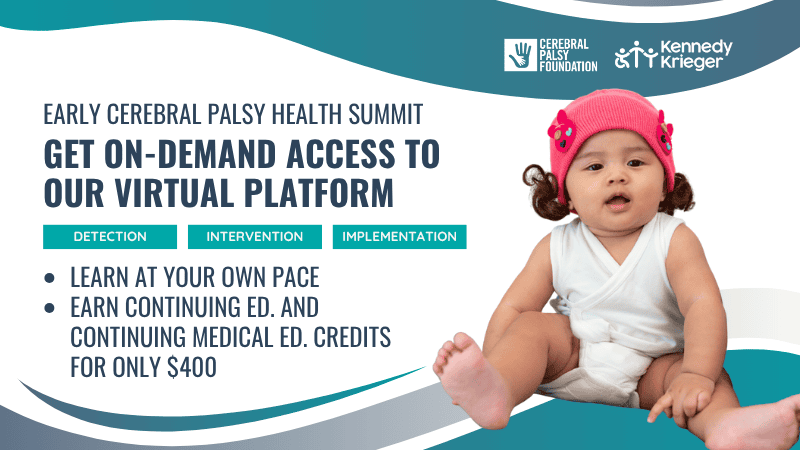
virtual early cerebral palsy health summit
REGISTRATION IS OPEN!
The 2026 Health Summit will share new pathways for translating knowledge into practice for the implementation of early detection and intervention of cerebral palsy from the best researchers and clinicians in the field.
Cerebral Palsy Foundation Education & Training Programs
-
Basic Early Detection E-Course
-
HINE Training
-
GMA Training
-
Upper Limb Intervention Training Courses
-
Early Cerebral Palsy Health Summit
-
Creating Connections
-
CP Advance
REVISED Basic Early Detection E-course
The revised Basic Early Detection E-course is coming January 15th, 2027. The new e-course is a 12.5 hours of virtual, asynchronous learning that provides clinicians with evidence-based tools to recognize early signs of cerebral palsy, promote timely diagnosis, and support families in their diagnostic journey. Each presentation aims to provide basic information that includes core knowledge of cerebral palsy, an introduction to early detection, the early detection pathway, conversation with families and implementation tools. Practical workshops will introduce early detection tools and assessments, and provides case examples to help the clinician translate knowledge into practice. The course will provide handouts, with an evidence table and references for each participant. A knowledge quiz will be required at the end of the course to receive a certificate of completion provided.
Who Should Attend
This course is ideal for pediatric providers who want to improve outcomes for high risk infants through early cerebral palsy diagnosis and intervention including: pediatricians, family practitioners, neonatologists, neurologists, occupational and physical therapists, nurses, nurse practitioners, researchers, trainees and students.
Workshops
1. Introduction to Early Detection for Cerebral Palsy presented by Rachel Byrne, Dr. Nathalie Maitre
2. The Basics of Cerebral Palsy presented by Dr. Nathalie Maitre
3. High-Risk for Cerebral Palsy and Clinical Decision-Making presented by Dr. Faith Kim, Dr. Andrea Duncan
4. Neuroimaging in Cerebral Palsy presented by Dr. Joanna Burton, Dr. Betsy Ostrander
5. Genetics in Cerebral Palsy presented by Dr. Betsy Ostrander, Dr. Darcy Fehlings
6. Standardized Neurological Exams to Inform Early Detection for Cerebral Palsy presented by Dr. Joanna Burton, Dr. Betsy Ostrander
7. Standardized Motor Assessments to Inform Early Detection for Cerebral Palsy presented by Dr. Barbara Sargent, Lynn Boswell
8. Challenging Conversations with Families presented by Dr. Nathalie Maitre, Dr. Mary Lauren Neel
9. Implementation Tools to Rapidly Improve your Early Cerebral Palsy Practice presented by Dr. Nathalie Maitre, Rachel Byrne
Learning Objectives
- Identify the early clinical signs and risk factors associated with cerebral palsy using evidence-based assessment and screening tools.
- Describe the role of neuroimaging, genetics, neurological examinations, and standardized motor assessments in the early detection and diagnosis of cerebral palsy.
- Apply clinical decision-making strategies to support timely referral, diagnosis, and intervention planning for infants at high risk for cerebral palsy.
- Demonstrate effective communication techniques for engaging and supporting families throughout the diagnostic journey and early intervention process.
- Integrate practical implementation tools and evidence-based practices into the workflow of clinical settings to improve early detection and intervention outcomes for children with cerebral palsy.
EDUCATION CREDITS
Continuing Education Credits (CE) Certificates will be provided upon completion of the post-activity survey, commensurate with hours of participation.
This continuing education has been approved by the Maryland State Board of Physical Therapy Examiners for 12.5 CE hours
The Cerebral Palsy Foundation is recognized by the New York State Board of Physical Therapy Examiners to approve up to 12.5 hours
If you have any feedback, questions or concerns, please email our Education Team. You will receive a response in the 3 business days. CPF appreciates your partnership in our mission be a catalyst for positive change for people with cerebral palsy.
HINE Training
The HINE Training is a 4-hour course including lecture, hands-on practical sessions, and Q&A discussions.The Hammersmith Infant Neurological Examination (HINE) is one of the early neurological examination tools for the diagnosis of CP. It is a simple and scorable method designed for evaluating infants between 2 months and 24 months of age. It includes 26 items that assess different aspects of neurological examinations such as cranial nerves, posture, movements, tone, and reflexes. The pro forma provides instructions for performing the individual items and diagrams to aid recording. The HINE is easily performed and accessible to all clinicians; it can be completed in 5 to 10 minutes. A good interobserver reliability has been reported, even in inexperienced staff.
Who Should Attend
This course is ideal for pediatric providers who want to improve outcomes for high risk infants through early cerebral palsy diagnosis and intervention in a multidisciplinary setting including: pediatricians, family practitioners, neonatologists, neurologists, occupational and physical therapists, nurses, nurse practitioners, researchers, trainees and students .
CPF is Advancing Early Detection through Training
Why is this important? The Hammersmith Infant Neurological Examination (HINE) is the gold-standard standardized neurological exam used to evaluate infants up to 24 months old who are at risk for cerebral palsy and other neurodevelopmental conditions. The Cerebral Palsy Foundation’s HINE Training Program includes over 20 trainers who have trained over 3,000 clinicians in the U.S. and around the world!
Do you want to host a HINE Training at your organization? Contact Kandace.Poindexter@yourcpf.org.
If you have any feedback, questions or concerns, please email our Education Team. You will receive a response in the 3 business days. CPF appreciates your partnership in our mission be a catalyst for positive change for people with cerebral palsy.
General Movement Assessment Training (Basic and Advanced)
Prechtl’s General Movements Assessment (GMA) is an evidence-based method for assessing spontaneous infant movements and supporting the early identification of infants at increased risk for cerebral palsy and other neurodevelopmental conditions. Courses are led by certified Prechtl GMA trainers and combine expert instruction with video-based learning.
Basic Course
Introduces the principles of GMA and builds skills in recognizing and classifying typical and atypical general movements from the preterm period through early infancy.
Advanced Course
Designed for professionals who have completed the Basic Course, the Advanced Course strengthens GMA skills through more complex case review, movement classification, and application in clinical practice.
The Basic and Advanced Course fulfill the standards specified by the GM-Trust.
Who Should Attend
Healthcare professionals involved in infant assessment and follow-up, including physicians, physical and occupational therapists, nurses, advanced practice providers, early intervention professionals, and researchers.
Learning Objectives:
- Recognize and classify typical and atypical general movements.
- Understand the role of GMA in early identification of neurodevelopmental risk.
- Develop practical skills through structured video-based assessment.
- Apply GMA findings within early detection and follow-up pathways.
If you have any feedback, questions or concerns, please email our Education Team. You will receive a response in the 3 business days. CPF appreciates your partnership in our mission be a catalyst for positive change for people with cerebral palsy.
Upper Limb Intervention Therapy Training Course: Multi-Sensory, Constraint Induced Movement & Bimanual Therapy for Children with Cerebral Palsy 3 months to 3 years
Upper Limb Intervention Therapy in Practice Course will allow participants to learn to apply and practice best evidence protocols for bimanual and multimodal interventions that have been demonstrated to improve arm and hand function specifically for children with CP. Participants will be trained in the science of the disorder and the mechanisms of the interventions, assessments to evaluate which protocol to use, delivery models, intervention exercises, the use of parent lesson plans and fidelity checks and self-monitoring. Workshops includes video and live demonstrations, skills checks, practice and self-assessments. Included in the course are manuals, a set of intervention materials and handouts.
Who Should Attend
This course is ideal for pediatric providers who want to improve outcomes for young children with unilateral cerebral palsy including: pediatricians, family practitioners, occupational and physical therapists, researchers, trainees and students
- Learning Objectives:
- 1. Learn and compare best-evidence upper extremity protocols for children 0-3 with and at high risk of cerebral palsy
- 2. Learn or refresh learning about the science of cerebral palsy and the mechanisms of the interventions used in selected protocols
- 3. Identify and discuss assessments used to help determine appropriate protocols
- 4. Learn to use a parent-led intervention plan, including applying therapist as a coach models, parent lesson plans, fidelity checks and self-monitoring
- 5. Practice applying protocols and discuss plan to implement protocols into practice
If you have any feedback, questions or concerns, please email our Education Team. You will receive a response in the 3 business days. CPF appreciates your partnership in our mission be a catalyst for positive change for people with cerebral palsy.
We can hardly wait to tell you! The location for the in-person 2027 summit to be announced soon!
CPF Early Cerebral Palsy Health Summit
The 2026 Virtual Early Cerebral Palsy HealthSummit is available until October 28th, 2026.
Who should attend:
Pediatric providers who want to improve outcomes for high risk infants through early cerebral palsy diagnosis and intervention in a multidisciplinary setting including: Pediatricians, Family Practitioners, Neonatologists, Neurologists, OTs, PTs. Nurses, Nurse Practitioers, Researchers and Trainees.
Learning Objectives:
1. To disseminate best evidence on new developments in early detection and interventions for Cerebral Palsy. Including: applied and translational sciences, prevention, diagnosis, treatment, and technology.
2. Increase awareness and learn implementation strategies for new and emerging treatments for individuals with cerebral palsy and other developmental disabilities.
3. Identify new modalities for the diagnosis of cerebral palsy and developmental disabilities.
4. Increase interprofessional collaboration and developing clinic-based frameworks to help coordinate and improve services across the continuum of care for individuals with cerebral palsy and developmental disabilities across the lifespan.
EDUCATION CREDITS FOR VIRTUAL SUMMIT
Continuing Education Credits (CE) Certificates will be provided upon completion of the post-activity survey commensurate with hours of participation.
This continuing education has been approved by the Maryland State Board of Physical Therapy Examiners for 48 CE hours.
A certificate of attendance is available to certify attendance and completion of professional development activity approved by the Cerebral Palsy Foundation for up to 48 hours.
Continuing Medical Education (CME)
This activity has been planned and implemented in accordance with the accreditation requirements and policies of the Accreditation Council for Continuing Medical Education (ACCME) through the joint providership of the American Academy of Pediatrics (AAP) and the Cerebral Palsy Foundation. The American Academy of Pediatrics is accredited by the ACCME to provide continuing medical education for physicians.
AAP designates this enduring material for a maximum of 45.0 AMA PRA Category 1 Credit(s)TM. Physicians should claim only the credit commensurate with the extent of their participation in the activity.
This activity is acceptable for a maximum of 45.0 AAP credits. These credits can be applied toward the AAP CME/CPD Award available to Fellows and Candidate Members of the American Academy of Pediatrics.
PAs may claim a maximum of 45.0 Category 1 credits for completing this activity. NCCPA accepts AMA PRA Category 1 Credit(s)TM from organizations accredited by the ACCME or a recognized state medical society.
If you have any feedback, questions or concerns, please email our Education Team. You will receive a response in the 3 business days. CPF appreciates your partnership in our mission be a catalyst for positive change for people with cerebral palsy.
Creating Connections
Creating Connection is a new one-day program designed to strengthen cerebral palsy knowledge and practice among professionals working in community-based settings. Delivered in partnership with Cerebral Palsy Foundation network sites, the program brings evidence, practical tools, and multidisciplinary expertise directly to local communities, with a focus on improving care and support across the lifespan.
Who Should Attend
Professionals who support people with cerebral palsy in community settings, including physical and occupational therapists, speech-language pathologists, physicians, nurses, advanced practice providers, social workers, educators, early intervention providers, and other health professionals.
Learning Objectives
- Strengthen connections between community professionals, specialist services, and CPF network sites.
- Strengthen knowledge of evidence-based cerebral palsy care across the lifespan.
- Translate current research and best practices into community-based care.
- Build skills to address the changing needs of children, adolescents, and adults with CP.
- Promote multidisciplinary, person- and family-centered approaches to care.
If you have any feedback, questions or concerns, please email our Education Team. You will receive a response in the 3 business days. CPF appreciates your partnership in our mission be a catalyst for positive change for people with cerebral palsy.
Coming soon!
CPAdvance
CPAdvance is an online course developed by Cerebral Palsy Alliance and offered in the United States by the Cerebral Palsy Foundation. The course is designed to strengthen clinicians’ understanding of the key principles of early intervention for infants with cerebral palsy, informed by the best available evidence.
Designed for occupational therapists, physical therapists, and speech-language pathologists, CP Advanced provides practical, evidence-based learning from international experts through presentations, recommended readings, and an extensive bibliography. The flexible, on-demand format allows professionals to build their knowledge and translate current evidence into everyday clinical practice.This learning platform has three levels:
Essentials: Foundational content shared across disciplines, including cerebral palsy in the early years, goal setting, assessment, caregiver coaching, environmental enrichment, play, caregiver well-being, and the caregiver–infant relationship.
Core: Discipline-specific clinical content for occupational therapy, physiotherapy, and speech pathology. OT and PT each have 11 Core modules; speech pathology has 8, with speech content emphasizing communication, feeding/eating and drinking, and AAC.
Electives: More specialized modules that allow clinicians to individualize their learning. Learners can also purchase smaller three-module bundles through a “Build Your Own Learning Journey” pathway.
Learning Objectives
1. Explain the presentation, diagnostic pathways, and prognostic trajectories of cerebral palsy in infancy, and apply clinical decision-making to select and justify evidence-based assessments that inform individualised, evidence-based intervention planning.
2. Apply coaching, sensitive communication, and family-centred practice skills to partner with caregivers in collaborative goal-setting and everyday decision-making, while recognising and responding to caregiver wellbeing and relational needs.
3. Apply clinical decision-making to design, implement, and grade task-specific training, cognitive, and communication (including AAC) interventions at the “just right” level of challenge for each infant.
4. Apply clinical decision-making to select, tailor, and justify feeding and swallowing support, specialised interventions (e.g., CIMT, bimanual training), and assistive technology or equipment options based on current evidence and the infant’s individual presentation.
5. Evaluate progress and goal-limiting factors, apply clinical decision-making to determine when referral to targeted services is needed, and embed interventions into sustainable, family-led routines.
If you have any feedback, questions or concerns, please email our Education Team. You will receive a response in the 3 business days. CPF appreciates your partnership in our mission be a catalyst for positive change for people with cerebral palsy.